
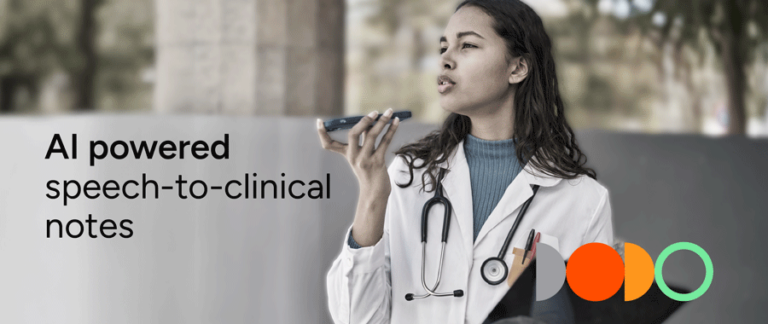
How AI-powered Speech-to-Clinical Notes is revolutionising clinical documentation
Doctors become doctors to care for patients, not to spend hours on paperwork. Yet, administrative tasks like writing clinical notes, updating patient records, & handling billing documentation can take up to almost 50% of a doctor’s time. This is in comparison to an average of 27% of their time on direct clinical face time with patients.
Additionally, a study in the International Journal of Health Services found that physicians spend an average of 8.7 hours per week (16.6% of their working hours) on administrative tasks. In South Africa, this burden is exacerbated by increasing patient loads, leaving many healthcare professionals stretched thin.
Clinical documentation is essential for quality patient care, but manual note-taking is inefficient, prone to errors, & contributes to burnout. A 2022 study found that among the 93% of doctors feeling burned out, 62% attributed excessive administrative burden as the main reason.
This is where AI-powered speech-to-clinical notes technology, is changing the game.
How our Speech-to-Clincal Notes Speeds Up Clinical Documentation
The Healthbridge Clinical advanced speech-to-clinical notes feature is designed specifically for doctors. It transcribes spoken notes in real-time (whether a full consultation with a patient or just their dictation after), converts them into structured clinical documentation, & integrates seamlessly into Healthbridge practice management systems.
- Efficiency & Time-Saving: Reducing Admin Work by up to 50%
Traditional note-taking is slow. Studies show that doctors type at an average speed of 30 words per minute, while dictation can be up to five times faster than typing.
- Doctors using speech-to-clinical notes software report saving up to 2 hours per day—time that can be reallocated to seeing more patients or improving work-life balance.
- Instead of spending 10-15 minutes per patient on documentation, doctors can dictate & review notes in under 5 minutes with AI assistance.
- Faster documentation means shorter consultation times—a critical advantage for high-volume private practices.
- Accuracy & Compliance: Reducing Errors & Enhancing Patient Safety
Handwritten or hastily typed notes often lead to inconsistencies, missing details, & transcription errors. AI-powered solutions like like our ambient AI medical scribe feature use natural language processing (NLP) specifically trained for medical terminology, ensuring highly accurate transcriptions.
- Avoids common errors associated with manual entry, such as misinterpreted handwriting or forgotten details.
- Structured clinical notes improve record-keeping, making it easier to retrieve patient histories.
- Ensures compliance with South African regulations such as POPIA (Protection of Personal Information Act) & HPCSA (Health Professions Council of South Africa) standards.
Addressing Common Concerns About AI in Clinical Documentation
Despite its benefits, some doctors are resistant to using AI for medical note-taking. Here’s how Healthbridge addresses the most common concerns:
- Is AI Accurate enough for medical notes?
Yes. The medical speech-to-clinical notes engine is trained to recognise complex medical terminology & South African accents, ensuring precise transcriptions. AI-powered dictation tools have significantly improved in accuracy over recent years, with many achieving accuracy rates above 95%.
- Is Speech-to-clinical notes software secure?
Absolutely. It is fully encrypted & compliant with POPIA, meaning patient data remains private & protected at all times.
- Is it easy to use?
The speech-to-Clinical Notes feature is designed for seamless integration into existing workflows. There’s no need for complex setups—doctors can start dictating within minutes & edit or review notes effortlessly.
The Future of Clinical Documentation
AI-powered speech-to-clinical notes technology is not replacing doctors—it’s enhancing their efficiency. By eliminating time-consuming manual tasks, it allows healthcare professionals to focus more on patient care & less on paperwork.
As AI adoption grows, speech-to-clinical notes technology is expected to become standard practice. Forward-thinking private practices that embrace tools like this will be better positioned for efficiency, accuracy, & improved patient experiences.
Speak. Treat. Care. Let AI Write the Notes.
AI-Powered Speech-to-Clinical Notes for South African Doctors
AI-Powered Speech-to-Clinical Notes turn your spoken consultations into structured, compliant clinical records in real time. Instead of typing while your patient talks, you simply speak — and AI creates accurate, organised notes for you to review and save. The result? Less screen time, more patient time, and dramatically reduced admin pressure in South African medical practices.
Studies show doctors spend close to half their working day on administration, while only about a quarter is spent in direct patient care. Speech-to-clinical-notes technology is designed to rebalance that equation — in favour of medicine, not paperwork.
From Conversation to Clinical Record — Instantly
Talk Like a Doctor. Get Notes Like a Professional.
Typing averages about 30 words per minute. Dictation is several times faster. AI speech recognition uses medical-grade language models to capture your voice, recognise clinical terminology, and turn natural conversation into structured medical notes.
In practice, this means:
- You speak during the consultation
- AI transcribes and structures your words
- Notes appear in formats like SOAP
- You review, edit if needed, and save
Doctors using AI dictation tools report saving up to two hours per day on documentation — time that can go back to patients, learning, or simply breathing.
Why Doctors Are Switching to AI Notes
Less Admin. More Medicine.
Manual notes are slow, inconsistent, and exhausting. AI-driven documentation changes the rhythm of your day:
- Fewer late nights finishing notes
- Shorter gaps between patients
- More eye contact, less keyboard contact
- Reduced risk of missing important details
AI doesn’t replace clinical judgment — it removes the clerical weight that drags it down.
Built for South African Healthcare
Designed Around Local Law, Not Just Global Tech
AI documentation in South Africa must respect:
- POPIA (Protection of Personal Information Act)
- HPCSA record-keeping standards
- Secure data storage and access control
Modern clinical AI systems are designed to:
- Encrypt patient data in transit and at rest
- Control user access with audit trails
- Support lawful processing and patient consent
- Retain records according to healthcare regulations
This makes AI documentation not just fast — but legally safe.
How AI Speech-to-Clinical Notes Works
Simple in Use. Powerful in Impact.
- You speak naturally during the consultation
- AI captures and transcribes your voice
- The system structures content into clinical format
- You review and finalise the note
- It saves directly into the patient record
No retyping. No double work. No lost details.
What Doctors Gain
|
Benefit |
What It Means in Real Life |
|
Time saving |
Up to 2 hours per day reclaimed |
|
Accuracy |
Medical-grade speech recognition |
|
Structure |
Automatic SOAP-style formatting |
|
Compliance |
POPIA-aligned data handling |
|
Patient care |
More attention, less distraction |
|
Workflow |
Direct EMR/EHR integration |
Smart Notes Meet Smart Billing
Healthbridge Medical Billing vs Outsourced Billing
Good notes don’t just protect patients — they protect income. Clear documentation supports correct coding and fewer claim rejections.
|
Feature |
Healthbridge In-House Billing + AI Notes |
Outsourced Medical Billing |
|
Control |
Full internal control |
Managed by external team |
|
Compliance |
Integrated clinical + billing compliance |
Bureau-managed compliance |
|
Visibility |
Immediate access to data |
Reports provided by service |
|
Staff needs |
Requires internal coordination |
Reduces in-house admin |
|
Cash flow |
Depends on internal efficiency |
Designed to improve payment speed |
Both models exist for different practice styles — AI notes strengthen either by improving documentation quality at the source.
Why AI Notes Reduce Burnout
Doctors worldwide report documentation as one of the biggest causes of burnout. Long evenings finishing notes, constant interruptions during consultations, and admin overload all contribute.
AI documentation helps by:
- Reducing after-hours admin
- Shortening consultation turnaround time
- Improving confidence in record accuracy
- Supporting better work-life balance
Technology doesn’t replace care — it protects the people who give it.
Data Security Comes First
Data security is fundamental to using AI in healthcare. Clinical AI tools must encrypt patient data both in storage and during transfer, log every access and system change, restrict user permissions based on roles, track patient consent, and comply fully with South Africa’s POPIA requirements. These controls protect sensitive medical information from misuse, breaches, and unauthorised access. Strong security also builds patient trust and protects medical practices from legal and reputational risk. Without proper encryption, access control, audit trails, and consent management, AI systems expose patients and providers to serious harm. For AI to be truly healthcare-ready, security and legal compliance must be built into every level of the system.
The Future Sounds Like This
You walk into the room.
You talk to your patient.
You examine, diagnose, explain.
And while you do — your notes write themselves.
AI-powered speech-to-clinical notes don’t change how you practise medicine.
They remove what gets in the way of it.
Ready to explore what digital transformation looks like in your practice?
Modern private practices don’t grow through disruptive projects. They improve through small, smart changes that remove friction & restore focus to patient care.
Healthbridge has helped over 7 000 practitioners move from paper-heavy workflows to integrated, AI-supported systems that make each day simpler & more predictable.
If you’d like guidance on starting your digital or AI journey, contact sales@healthbridge.co.za.
Frequently Asked Questions
How do I start using AI notes in my practice?
Activate the feature in your EMR, complete the setup process, and start dictating during consultations.
How do I check if the AI is accurate?
Review the note immediately after dictation and edit anything that needs correction before saving.
How do I connect AI notes to my patient records?
AI notes integrate directly into compatible EMR systems and save automatically into the patient file.
How do I get patient consent for AI recording?
Explain that AI is used for documentation and record verbal consent in line with POPIA guidelines.
How do I edit AI-generated notes?
Open the draft, edit like a normal note, and finalise when satisfied.
How do I know my data is secure?
Choose systems that use encryption, access controls, and audit trails aligned with POPIA.
How do I train staff to use it?
Provide short training sessions on starting dictation, reviewing notes, and saving correctly.
How do I avoid errors in dictation?
Speak clearly, review carefully, and correct immediately before finalising.
How do I audit note activity?
Use built-in audit logs that show who created or edited each note and when.
How do AI notes affect medical billing?
Better documentation improves coding accuracy and can reduce rejected or delayed claims.
Doctor testimonials

Take the next step in practice evolution
If clinical admin is slowing you down, it’s time to explore how our Speech-to-Clinical Notes feature can transform your practice.
- Address: Pin Oak House, Ballyoaks Office Park, 35 Ballyclare Drive, Bryanston, 2191
- Hours: Mon-Fri 8:00AM - 5:00PM
- Phone: 0860 200 222
- Email: sales@healthbridge.co.za